
Speed Limits Are a Ceiling, Not a Target

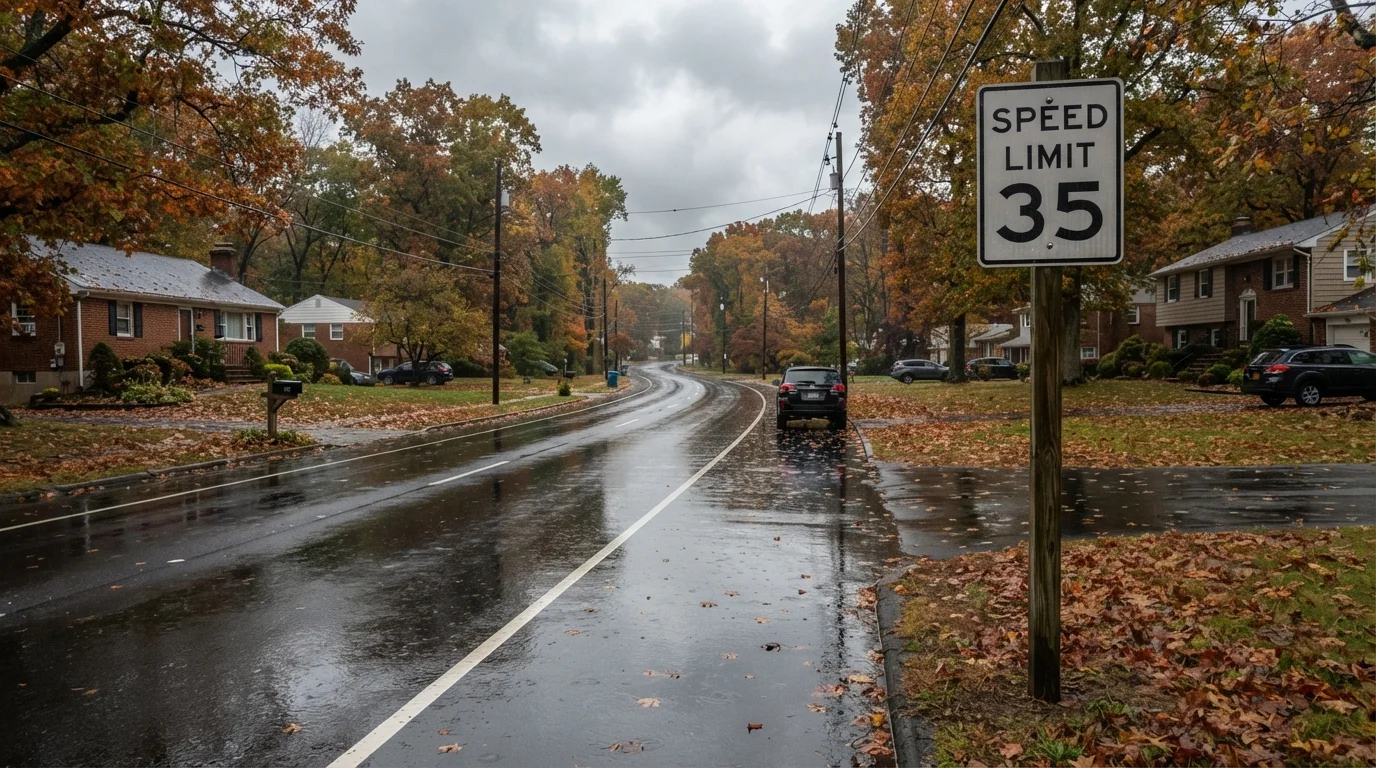
Photo: InfoAlly.net | Finding Info Made Easy editorial
Key Takeaways
- Speed limits represent the legal maximum under ideal conditions, not a recommended driving speed.
- Weather, traffic density, road design, and visibility all require drivers to travel below the posted limit.
- Driving at the limit in poor conditions significantly increases stopping distance and crash severity.
- Adjusting speed proactively - not reactively - is a core safe-driving habit supported by traffic safety research.
What Speed Limits Actually Tell You
A posted speed limit does one specific job: it sets the legal ceiling for vehicle speed on that road segment under normal, favorable conditions. Traffic engineers establish limits by studying road geometry, typical traffic volumes, pedestrian activity, and sight lines. They do not account for the rain that started an hour ago, the school bus that just pulled over, or the sun sitting directly in your line of sight at 7:30 a.m.
This distinction matters enormously. A driver who treats 45 mph as the "right" speed simply because the sign says 45 is making a consequential reasoning error - one that U.S. traffic safety data consistently links to higher crash rates and greater injury severity. Speed limits describe a boundary, not a destination.
Myth
Driving at the posted speed limit is always the safe and correct speed for that road.
Fact
Speed limits are legal maximums for ideal conditions. Rain, fog, traffic, and road changes all require driving below the posted limit.
Traffic engineers set limits based on road design and typical conditions - not the worst-case scenarios drivers regularly encounter. Traveling at 55 mph in heavy rain on a 55 mph highway is legal, but physics does not respect legality. Stopping distances extend dramatically on wet pavement, and the risk of losing control rises substantially. Safe speed is always a function of current conditions, not the sign on the roadside.
Myth
If you're driving at or under the limit, you can't be at fault in a collision.
Fact
Drivers can be found legally and factually at fault for collisions even when traveling at or below the posted speed, if conditions required a lower speed.
U.S. traffic law generally requires drivers to travel at a speed that is "reasonable and prudent" for existing conditions - a standard that exists independent of posted limits in most states. A driver going 40 mph in a 45 mph zone during a whiteout blizzard may still be considered negligent if that speed contributed to a crash. Posted limits set the upper bound; driver judgment sets the practical safe speed.
Myth
Slowing below the speed limit disrupts traffic and is itself dangerous.
Fact
Briefly traveling below the limit to navigate a hazard or poor conditions is a standard safe-driving practice; erratic or unpredictably slow speeds in normal conditions are a separate concern.
There is an important difference between appropriately reducing speed for a curve, a construction zone, or wet pavement, and crawling at 20 mph on a clear, dry interstate for no reason. The former is basic hazard management taught in every driver's education course. The latter can indeed create differential-speed conflicts with surrounding traffic. Drivers should signal intentions clearly and return to a normal, traffic-compatible speed as soon as conditions allow.
Myth
Higher speed limits on highways mean highway driving is inherently safer than city driving.
Fact
Crash severity increases sharply with speed, and highway crashes - though less frequent per mile - tend to involve higher-energy collisions with more serious outcomes.
Crash energy scales with the square of speed: doubling your speed quadruples the kinetic energy your vehicle carries into a collision. Federal highway safety data consistently shows that run-off-road and multi-vehicle crashes at freeway speeds produce disproportionately severe injuries. Urban environments involve more frequent low-speed interactions but not necessarily greater overall risk per trip when drivers adjust behavior appropriately.
How Conditions Change the Safe Speed Equation
Several factors routinely make the posted limit unsafe, even for attentive, experienced drivers:
- Wet or icy pavement: Stopping distances can increase by 50-200% on wet roads compared to dry asphalt, depending on tire tread depth and vehicle weight. At highway speeds, aquaplaning can occur before most drivers react.
- Reduced visibility: Fog, heavy rain, glare, and darkness all shrink the effective distance you can see and respond to hazards. Your safe stopping speed should never exceed your ability to stop within your visible range ahead.
- Heavy traffic: When vehicles are traveling closely together, even a modest speed creates far less reaction time than open-road conditions. The two-second following-distance rule - described in detail in our article on tailgating and stopping distances - becomes even harder to maintain as speed rises.
- Road construction and temporary changes: Lane narrowing, altered geometry, and unpredictable worker or equipment presence make posted construction-zone limits a ceiling - not a floor.
- Curves and intersections: Even on dry roads, posted limits may exceed what physics allows through a sharp bend, particularly for taller or heavier vehicles.
2×-3×
Increase in stopping distance on wet roads
Traffic safety research broadly documents that wet pavement can double or triple stopping distances compared to dry conditions at equivalent speeds.
~31%
Of traffic fatalities linked to speeding
The National Highway Traffic Safety Administration (NHTSA) has consistently found that speeding is a contributing factor in roughly one-third of U.S. traffic fatalities annually.
None of this requires split-second superhuman judgment. It requires drivers to build a habit: look ahead, read conditions, and dial speed down before a hazard closes in - not during it.
Adjusting Speed Is a Skill, Not an Inconvenience
Proactive speed adjustment is one of the highest-value driving habits you can develop. It reduces fuel consumption - aggressive speed swings and hard braking waste significantly more fuel than steady moderate speeds - and it creates the time buffer that prevents minor situations from becoming emergencies.
Practical ways to build this habit:
- Before every trip, spend ten seconds noting weather and light conditions, and mentally set an expectation to travel below the limit if either is compromised.
- On unfamiliar roads, treat the posted limit as a ceiling to approach gradually, not a speed to match immediately.
- In school zones and residential streets, recognize that the legal limit was already set conservatively - children and cyclists can enter the road unpredictably, so leaving margin is wise regardless of legality.
- After any change in conditions - a downpour, a fog bank, a sudden drop in visibility - actively reduce speed before you need to stop, not as you need to stop.
Speed Adjustment Is Not Optional in Poor Conditions
This article provides general driver education information and is not a substitute for a certified driver training program or your state's official traffic laws. Always comply with current posted limits and local regulations.
The content on this site is for informational purposes only and is not a substitute for professional advice. Always consult a qualified professional for guidance specific to your situation.