
Tailgating: The Habit That Makes Every Road More Dangerous

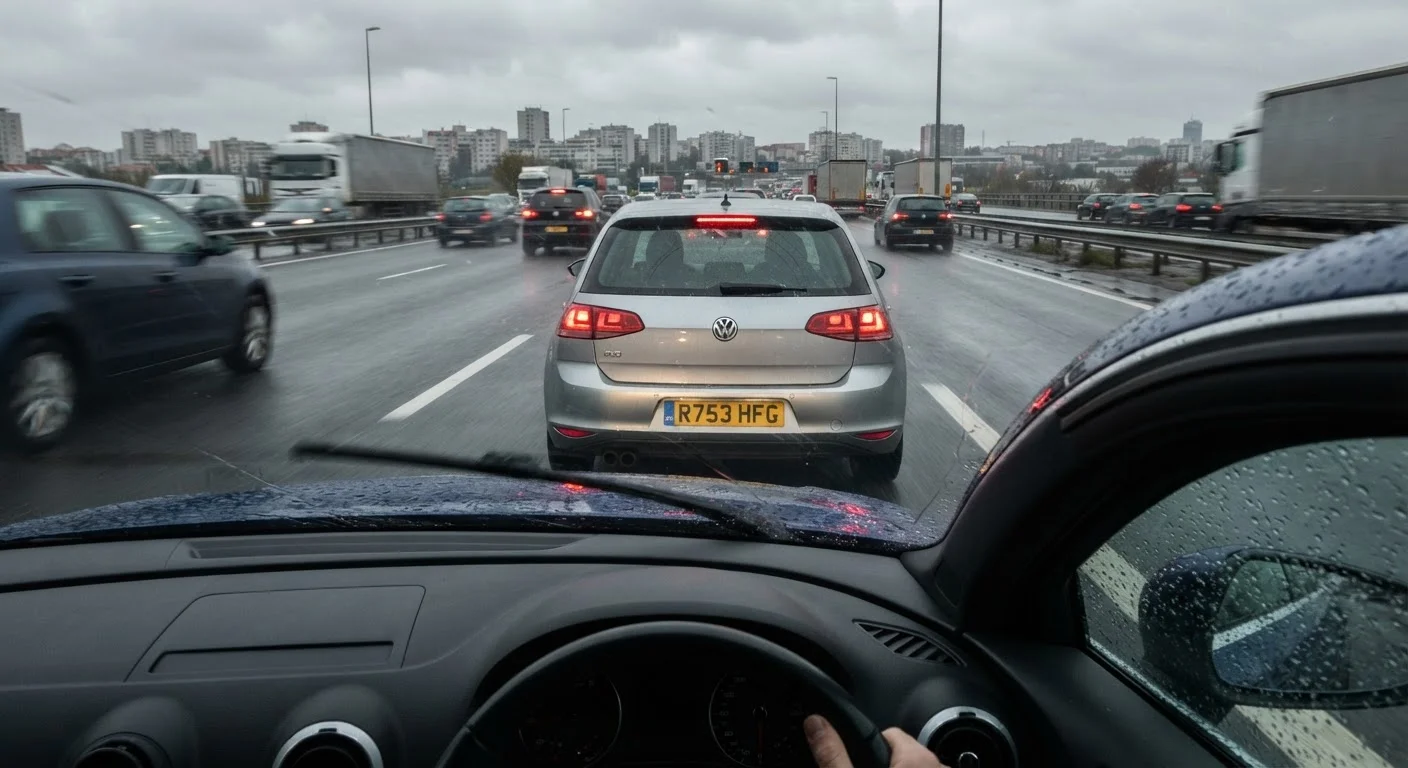
Photo: InfoAlly.net | Finding Info Made Easy editorial
Key Takeaways
- The two-second rule is the minimum safe following distance under ideal conditions.
- Rear-end collisions are among the most common crash types, and tailgating is a primary cause.
- Stopping distance increases dramatically with speed - doubling speed more than doubles stopping distance.
- Tailgating provides almost no time advantage on a typical journey.
- Wet or low-visibility conditions require significantly greater following distances than the two-second baseline.
Why Tailgating Is Riskier Than It Feels
Tailgating - following the vehicle ahead more closely than stopping distance allows - is one of the most persistent dangerous habits on American roads. Unlike speeding, which registers instinctively as risky, following too closely often feels controlled and even assertive. That disconnect between perception and reality is precisely what makes it so dangerous.
Rear-end collisions consistently rank among the most frequent crash types recorded by traffic safety researchers. A significant proportion involve following distances that left drivers no viable stopping room once the vehicle ahead slowed or stopped. Understanding why this happens - and the cognitive errors that enable it - is the first step to building a safer habit.
~29%
Of all U.S. crashes that are rear-end collisions
According to the National Highway Traffic Safety Administration (NHTSA), rear-end crashes are among the most common collision types on U.S. roads, frequently linked to following too closely.
1.5 sec
Average driver perception-reaction time
Traffic safety research commonly cites approximately 1.5 seconds as a typical perception-reaction time - the gap between recognising a hazard and applying the brake.
180+ ft
Total stopping distance at 60 mph on dry road
This estimate, widely cited in driver education materials, combines perception-reaction distance and braking distance under normal dry conditions.
The core problem is physics. At higher speeds, stopping distance grows not linearly but exponentially. A car traveling at 60 mph requires roughly twice the stopping distance of one traveling at 40 mph, not just 50% more. Most drivers have never tested their vehicle's full stopping performance and therefore carry unrealistic mental models of how much space they actually need.
Common Tailgating Mistakes and How to Avoid Them
The following errors represent the most common ways drivers fall into - and stay in - the tailgating habit. Each has a practical, traffic-tested correction.
Applying the two-second rule as a universal fix regardless of conditions.
Assuming that closing the gap will meaningfully reduce journey time.
Failing to recalculate following distance after a speed increase.
Underestimating the role of perception-reaction time in stopping distance.
Tailgating in response to frustration with a slow vehicle ahead.
Night and Low-Visibility Conditions Multiply the Risk
For a broader framework on anticipating hazards before they require emergency response, see our end-to-end safe driving guide. Building correct following-distance habits fits within a larger pattern of attention and spatial awareness that understanding speed limits and motorway merging also depend on.
The content on this site is for informational purposes only and is not a substitute for professional advice. Always consult a qualified professional for guidance specific to your situation.