
Safe and Smart Driving: An End-to-End Guide for Everyday Drivers

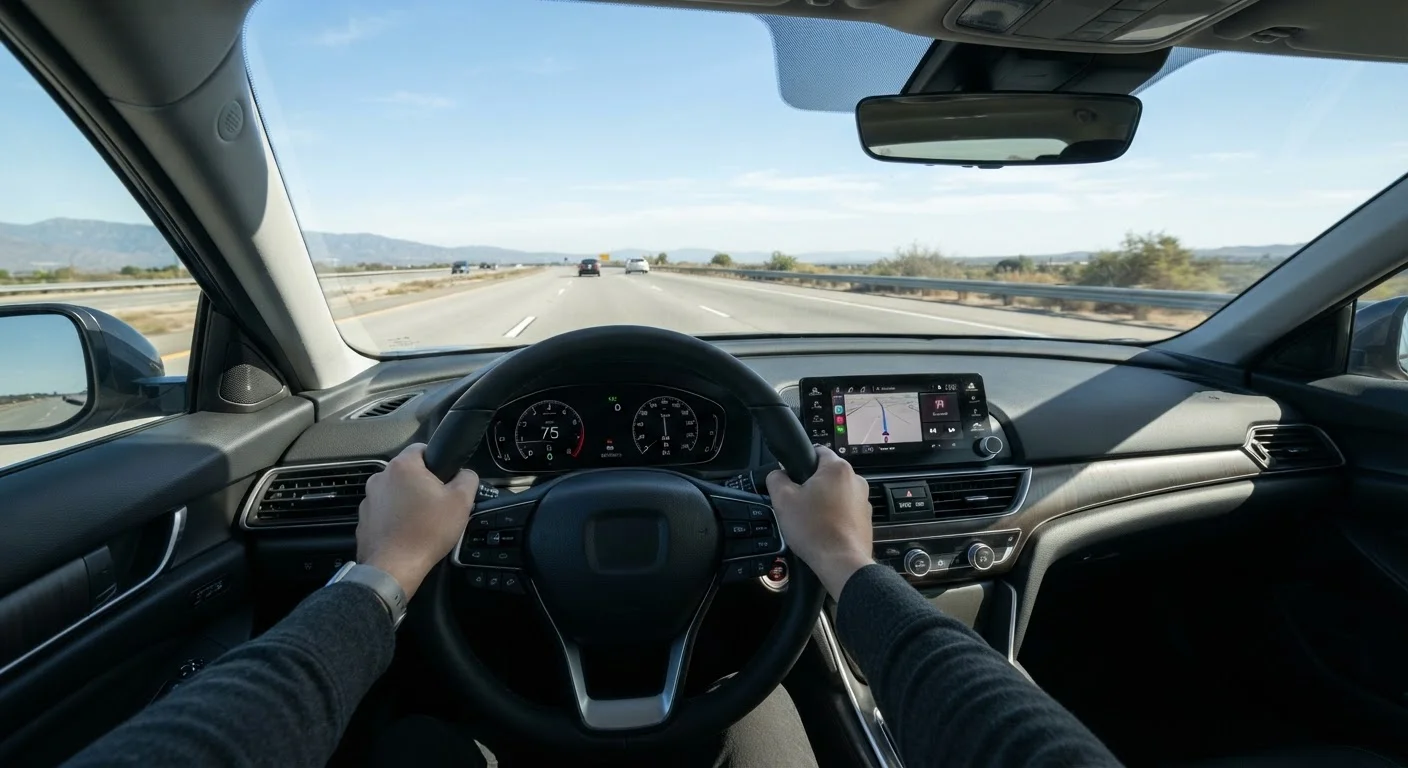
Photo: InfoAlly.net | Finding Info Made Easy editorial
Key Takeaways
- A two-minute pre-drive check catches faults before they become roadside emergencies.
- Scanning ahead 12-15 seconds gives you time to respond rather than react.
- Smooth acceleration and early braking can meaningfully reduce fuel consumption.
- Cognitive distraction - including hands-free phone use - significantly raises crash risk.
- Adapting your technique to weather, road type, and time of day is a core safety skill.
Pre-Drive Checks: Building a Habit Before You Move
Most mechanical breakdowns and many collisions trace back to issues that were present before the journey even began. A structured pre-drive routine - taking no more than two minutes - can catch tire pressure loss, low fluids, or malfunctioning lights before they become emergencies on a busy road.
Walk around the vehicle and visually inspect all four tires for obvious deflation or damage. Check that all exterior lights function, including brake lights (a second person or a wall reflection helps here). Inside, confirm your mirrors are correctly positioned for your seating position - not a previous driver's. Adjust seat position so you can fully depress the brake pedal with a slight bend remaining in your knee, maintaining full control without strain.
Fluids worth monitoring regularly include engine oil, coolant, and washer fluid. While you don't need to check every fluid daily, a weekly habit of glancing at your dashboard warning lights and a monthly under-hood check is a reasonable baseline for most drivers. For a fuller picture of ongoing vehicle care, the complete guide to car ownership covers maintenance across the full ownership lifecycle.
Make Your Mirror Check a Reflex
Hazard Awareness and Situational Thinking
Hazard awareness is the ability to read a developing situation early enough to respond safely - not react desperately. The foundation is a simple technique: scan the road 12 to 15 seconds ahead of your current position. At 60 mph, that's roughly a quarter mile. This forward scan gives your brain time to process potential threats - a pedestrian about to step off a curb, a vehicle stopped in a merge lane, brake lights cascading ahead.
Complement the forward scan with regular mirror checks. A standard sequence - center mirror, left mirror, right mirror - repeated roughly every five to eight seconds keeps your mental picture of surrounding traffic current. When changing lanes or preparing to turn, add a shoulder check to cover blind spots that mirrors cannot fully capture.
The defensive driving mindset goes deeper into anticipation as a safety philosophy, including how to manage space buffers and read driver behavior patterns.
94%
Crashes involving human choice or error
According to NHTSA research, the vast majority of crashes involve a human factor as a critical reason.
10x
Stopping distance increase on ice vs. dry road
Road safety agencies widely cite this multiplier as a general guide to ice-driving risk at equivalent speeds.
4 sec
Recommended following gap in wet conditions
Standard driver training guidance doubles the dry-road two-second rule when roads are wet.
Motorway and Highway Confidence
High-speed roads reward smoothness and planning. Merging onto a motorway requires matching the speed of traffic in the target lane - not yielding to a crawl and forcing other drivers to adjust. Use the full length of the acceleration ramp, signal early, and select a gap before you reach the merge point.
Lane discipline matters for both safety and traffic flow. Unless actively overtaking, keeping to the right lane (in right-hand-traffic countries) reduces interaction points with merging vehicles and is typically required by law. When following, the standard guidance is a minimum two-second gap in dry conditions - increasing to four seconds or more in rain, and further still on ice or in fog.
Exiting is as important as entering: signal well in advance, reduce speed progressively on the exit ramp rather than braking sharply on the motorway itself, and recalibrate your speed perception once on lower-speed roads - highway speeds can make 40 mph feel deceptively slow. See how highway and city driving demand different skills for a detailed comparison of these two environments.
Fuel Efficiency: Driving Habits That Save Money
Fuel economy is shaped more by driving behavior than most drivers realize. Hard acceleration followed by hard braking is the most wasteful pattern common on everyday roads. Smooth, gradual acceleration allows the engine to build momentum efficiently, while anticipating stops and coasting to a deceleration point rather than braking late reduces both fuel use and brake wear.
Maintaining a steady speed on open roads is where cruise control earns its value - even minor speed fluctuations increase fuel consumption over distance. Keeping tires inflated to the manufacturer's recommended pressure (found in the vehicle door jamb, not the tire sidewall) can improve fuel economy by a measurable margin, since underinflated tires increase rolling resistance.
Air conditioning adds engine load; at lower speeds, opening windows may be more efficient. At highway speeds, the aerodynamic drag from open windows can outweigh the AC load - the crossover point varies by vehicle. Roof racks and cargo carriers also create significant drag when empty; removing them when not in use is a straightforward efficiency gain.
Look at where you want to go, not at what you're trying to avoid. The vehicle tends to follow your focal point - experienced drivers use this to steer through tight situations more accurately.
When fuel economy matters, shift to higher gears earlier in your RPM range and keep engine revs low on steady roads - most modern engines operate most efficiently between 1,500 and 2,500 RPM.
Distraction, Fatigue, and the Human Factor
Human error is the contributing factor in the majority of road collisions. Two categories consistently appear in crash data: distraction and fatigue. Both impair the cognitive processing needed for hazard awareness, even when a driver feels capable.
Distraction is not limited to handheld phone use. Research consistently shows that hands-free phone conversations meaningfully reduce a driver's ability to detect and respond to hazards - the cognitive load, not the physical act, is the primary issue. In-vehicle infotainment systems, navigation inputs, and even complex conversations with passengers all draw on the same limited attention resource.
Fatigue is more insidious because its onset is gradual and self-assessment is unreliable - people experiencing significant fatigue often underestimate its effect on their performance. Early warning signs include missing exits, drifting within lane, difficulty maintaining speed, and heavy eyelids. When these appear, the only safe response is to stop and rest. Caffeine can delay fatigue briefly, but it does not substitute for sleep. For night-specific strategies, night driving habits that reduce fatigue and improve visibility provides practical guidance.
Hands-Free Does Not Mean Risk-Free
Weather and Low-Visibility Conditions
Adapting to conditions is a mark of a skilled driver. Rain, fog, and ice each change the physics of your vehicle's behavior and reduce the margin for error. The single most important adjustment in poor weather is speed - not because of an arbitrary caution, but because stopping distances increase dramatically on wet and icy surfaces. On ice, stopping distances can be ten times longer than on dry pavement at the same speed.
In fog, use low-beam headlights - high beams reflect off fog particles and reduce visibility further. Rear fog lights are appropriate when visibility drops below roughly 300 feet, but should be switched off when conditions improve to avoid blinding following drivers. Keep ventilation running to prevent windshield fogging from the inside.
In heavy rain, be alert for hydroplaning - a condition where tires ride on a film of water and lose contact with the road surface. If it occurs, ease off the throttle gently without braking sharply or turning abruptly, and allow the tires to regain contact naturally. Tire tread depth is the primary defense against hydroplaning; worn tires perform significantly worse in wet conditions.
This article is for general informational purposes only. Always follow applicable traffic laws and consult a qualified mechanic for vehicle-specific maintenance concerns.
The content on this site is for informational purposes only and is not a substitute for professional advice. Always consult a qualified professional for guidance specific to your situation.