
Credit Scores Demystified: What the Number Actually Measures

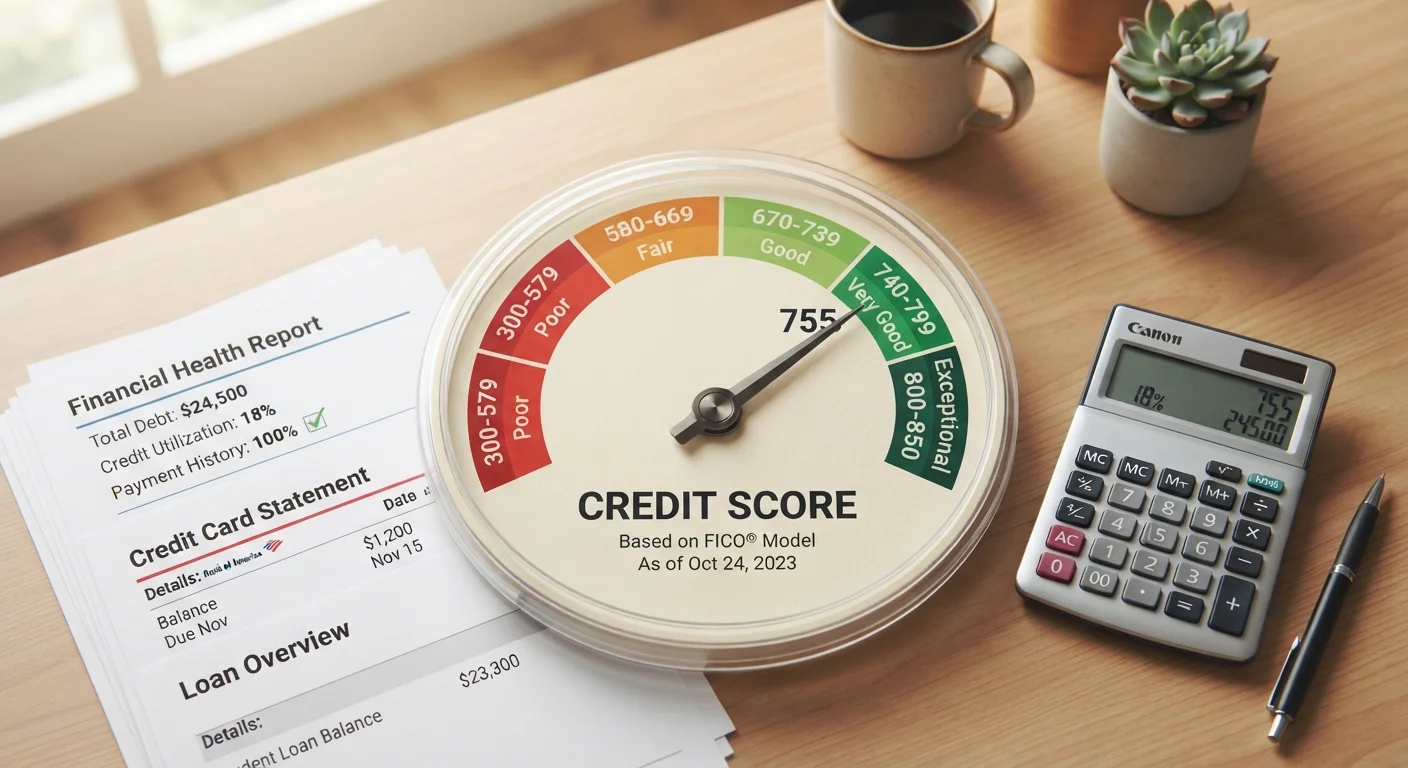
Photo: InfoAlly.net | Finding Info Made Easy editorial
Key Takeaways
- A credit score ranges from 300 to 850 and reflects your history of managing borrowed money.
- Payment history is the single most influential factor, making up about 35% of a FICO® Score.
- Credit utilization - how much of your available credit you're using - accounts for roughly 30%.
- Scores are calculated from data in your credit report, which you can review for free.
- Multiple scoring models exist; lenders may use different versions when evaluating your application.
What a Credit Score Actually Represents
At its core, a credit score is a statistical prediction - a lender's best estimate of whether you'll repay what you borrow. It doesn't measure your income, your savings, or your overall financial health. Instead, it focuses narrowly on your borrowing behavior as recorded in your credit report.
Think of it as a track record summary. Every time you've opened an account, made a payment, or carried a balance, that activity has been logged. A credit score compresses that history into a single number so a lender can make a fast, consistent assessment - often before a human even reviews your full application.
For a broader foundation on credit concepts, see our comprehensive debt and credit guide.
≈35%
Weight of payment history in FICO® Score
According to FICO®, payment history is the single largest factor in most scoring models.
300-850
Standard FICO® Score range
The FICO® Score range is the most widely recognized scale used by US lenders to evaluate credit risk.
3
Major US credit bureaus reporting score data
Equifax, Experian, and TransUnion each maintain independent credit files, which can produce slightly different scores.
The Five Factors Behind the Number
Under the widely used FICO® scoring model, five categories of information determine your score, each carrying a different weight:
- Payment history (≈35%): Whether you've paid bills on time. A single missed payment can have a notable negative effect, especially on an otherwise clean record.
- Credit utilization (≈30%): The percentage of your total available revolving credit you're currently using. Lower utilization is generally better; many financial educators suggest keeping it below 30%.
- Length of credit history (≈15%): How long your accounts have been open, including the age of your oldest account, newest account, and the average across all accounts.
- Credit mix (≈10%): Whether you have experience with different types of credit - such as credit cards, installment loans, and mortgages. A diverse mix can signal broader borrowing experience.
- New credit (≈10%): Recent applications for new accounts. Each hard inquiry can cause a small, short-term dip in your score.
For a deeper look at how these factors evolve over time, our breakdown of score-shaping factors walks through each element month by month.
Keep Utilization Low, Even If You Pay in Full
Why Lenders Care - and What They Do With the Number
Lenders are in the business of managing risk. Before extending a mortgage, car loan, or credit card, they need a standardized way to gauge repayment likelihood across thousands of applicants. A credit score provides that consistency.
A higher score can influence more than just approval odds. It often affects the interest rate offered, the credit limit extended, and in some cases, whether a security deposit is required - for example, on a utility account or apartment lease. Employers in certain industries may also review credit reports (though not scores) as part of background checks.
Scores Vary by Model and Bureau
It's worth knowing that your score is just one input into a lender's decision. Income, employment history, existing debt load, and the size of the loan requested all factor in separately. A strong credit score doesn't guarantee approval, and a lower score doesn't always mean automatic rejection.
If your score has moved unexpectedly, our article on why scores drop without obvious cause explains the most common hidden reasons.
Reading the Data Behind Your Score
Your credit score is only as accurate as the data in your credit report. The report - maintained by the three major bureaus: Equifax, Experian, and TransUnion - contains the raw account information that feeds every scoring model. Errors in that report can drag down an otherwise solid score.
Under federal law, consumers in the US are entitled to free credit reports from each bureau. Reviewing your report periodically is one of the most straightforward ways to catch inaccuracies - a misreported late payment, an account you don't recognize, or a balance that wasn't updated after payoff.
If you'd like a guided walkthrough of what you'll find, our article on reading your credit report without feeling overwhelmed breaks down every section in plain language.
This article is for general informational and educational purposes only and does not constitute personalized financial or legal advice. Please consult a qualified financial professional for guidance specific to your situation.
Frequently Asked Questions
The content on this site is for informational purposes only and is not a substitute for professional advice. Always consult a qualified professional for guidance specific to your situation.