
Unit Price vs. Sticker Price: What the Shelf Tag Is Really Telling You

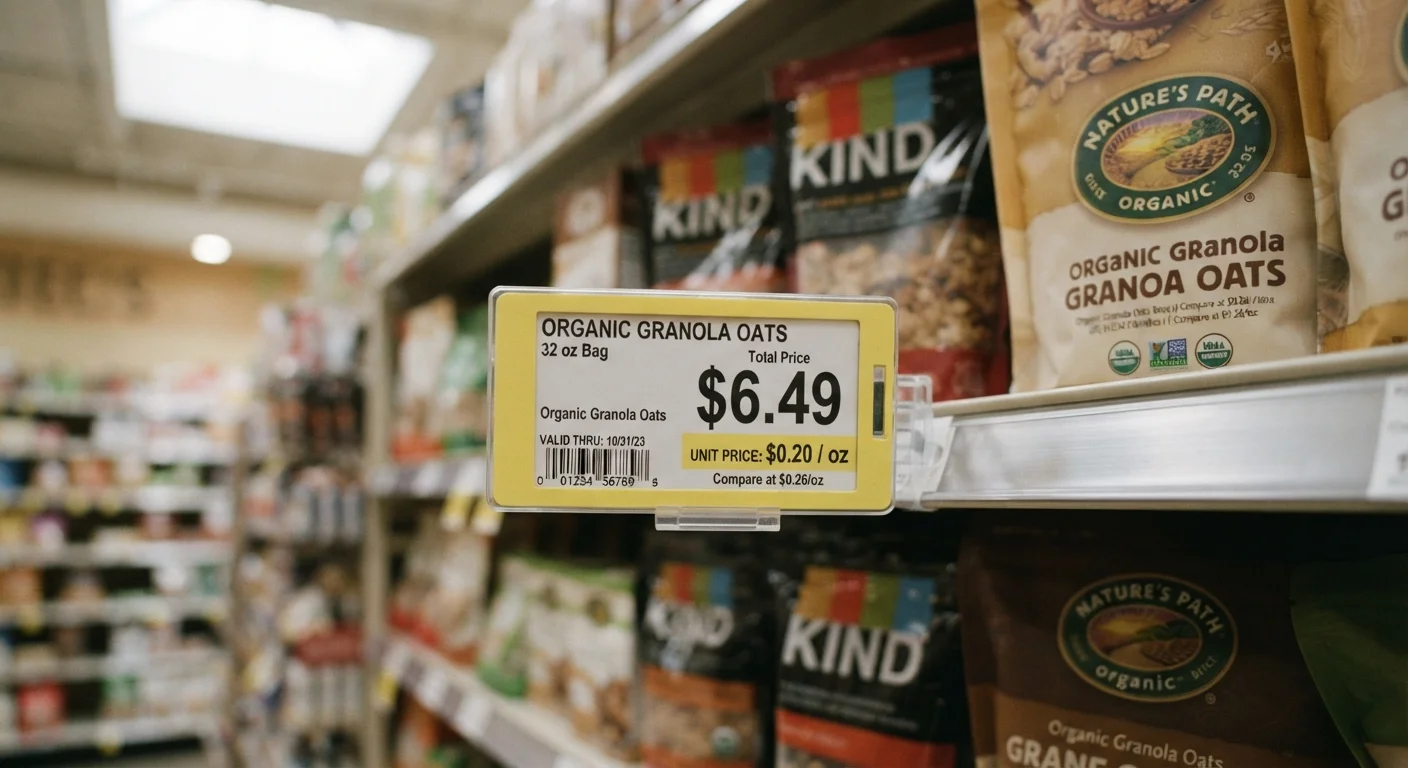
Photo: InfoAlly.net | Finding Info Made Easy editorial
Key Takeaways
- The sticker price tells you what you'll pay at checkout; the unit price tells you what you're actually getting for that money.
- Bigger packages don't always have a lower unit price - you should verify before assuming bulk is cheaper.
- Unit prices use different base measurements, so always confirm you're comparing the same unit across products.
- Sales and store brands can dramatically change which product has the lowest unit price week to week.
- Understanding unit pricing is one of the fastest, most practical ways to reduce your grocery bill without changing what you buy.
Two Numbers, Two Different Questions
Every shelf tag in a grocery store answers two separate questions. The large, prominent sticker price answers: how much will this cost me at checkout? The smaller unit price answers something far more useful: how much am I paying for each ounce, each count, or each pound of this product?
Most shoppers focus entirely on the sticker price. That's understandable - it's bigger, bolder, and directly tied to what leaves your wallet. But sticker price alone tells you almost nothing about whether you're getting a fair deal. A $4 jar of peanut butter and a $6 jar of peanut butter could be identical in value, or one could be dramatically better - the only way to know is to look at the unit price.
This distinction matters because manufacturers package the same product in a wide variety of sizes, and the price-per-unit relationship doesn't scale evenly. Once you start reading the unit price habitually, the sticker price becomes just a budget checkpoint, not a value judgment.
How to Read the Unit Price Label
A typical shelf label shows the unit price in a small box, usually expressed as a cost per standard measurement. Common formats include:
- Per ounce (oz) - common for food, beverages, and personal care products
- Per count (ct) - used for items sold by quantity, like vitamins, trash bags, or paper towels
- Per pound (lb) - frequently seen for fresh produce, meat, and bulk goods
- Per 100 ml or per liter - sometimes used for liquid products
The key rule: only compare unit prices that use the same base measurement. A unit price listed as cost-per-ounce can't be directly compared to one listed as cost-per-pound without converting. When you notice two products using different units, either do the math or look for a shelf tag version that standardizes them.
~$500
Annual savings possible through consistent unit price comparison
Consumer advocacy research has suggested that households that routinely compare unit prices can realize meaningful annual savings on grocery spending, though exact figures vary by household size and purchasing habits.
30%+
Unit price difference between sizes of the same product
Independent grocery price analyses have found that unit price differences between package sizes of the same product can exceed 30%, with smaller sizes often - but not always - carrying the higher cost per unit.
If a unit price isn't displayed, the calculation is straightforward: divide the sticker price by the number of units on the package. A 32 oz bottle priced at $3.84 has a unit price of $0.12 per ounce. A 20 oz bottle at $2.60 comes to $0.13 per ounce - slightly worse, even though the sticker price is lower.
When Bigger Isn't Always Cheaper Per Unit
The widespread assumption is that larger packages always offer a better unit price. This is often - but not always - true. There are several situations where the smaller size actually wins on unit cost:
- Promotional pricing on smaller sizes: Stores frequently run sales on mid-size products, temporarily pushing their unit price below the larger format.
- Store brand vs. name brand: A store-brand smaller package can easily beat a name-brand large package on unit price.
- Multi-packs vs. single bulk: Bundled multi-packs sometimes cost more per unit than buying a single large container of the same product.
Make Unit Price Your Default Comparison
The only reliable way to know which size wins is to look at the unit price on each label and compare directly. This habit takes about five seconds per item and can meaningfully reduce a grocery bill over time - without requiring any change to what you buy. For a broader take on how price and value relate beyond the grocery store, see how price relates to true value in bigger purchasing decisions.
Unit Pricing in Context: What It Can't Tell You
Unit pricing is a powerful tool, but it has limits worth knowing. It tells you the cost per standard measurement - it says nothing about quality, ingredient sourcing, concentration (especially relevant for cleaning products or supplements), or how much of a product you'll realistically use.
For products where concentration varies - like laundry detergent or juice - the unit price per ounce can be misleading if one product is diluted and another is concentrated. In those cases, look at the recommended dose or serving size to compare true usage cost. This is similar to how cost per use gives a more complete picture than sticker price for durable goods.
Unit pricing also doesn't factor in your actual consumption patterns. The better unit price on a gallon of milk means nothing if you're a one-person household who won't finish it before it expires. Waste cancels out savings.
Used alongside reading a nutrition label, unit pricing gives you a complete view of both the financial and nutritional value of what you're putting in your cart - a combination that turns routine grocery shopping into genuinely informed decision-making.
Frequently Asked Questions
The content on this site is for informational purposes only and is not a substitute for professional advice. Always consult a qualified professional for guidance specific to your situation.