
Seven Everyday Gadgets That Quietly Earn Their Counter Space

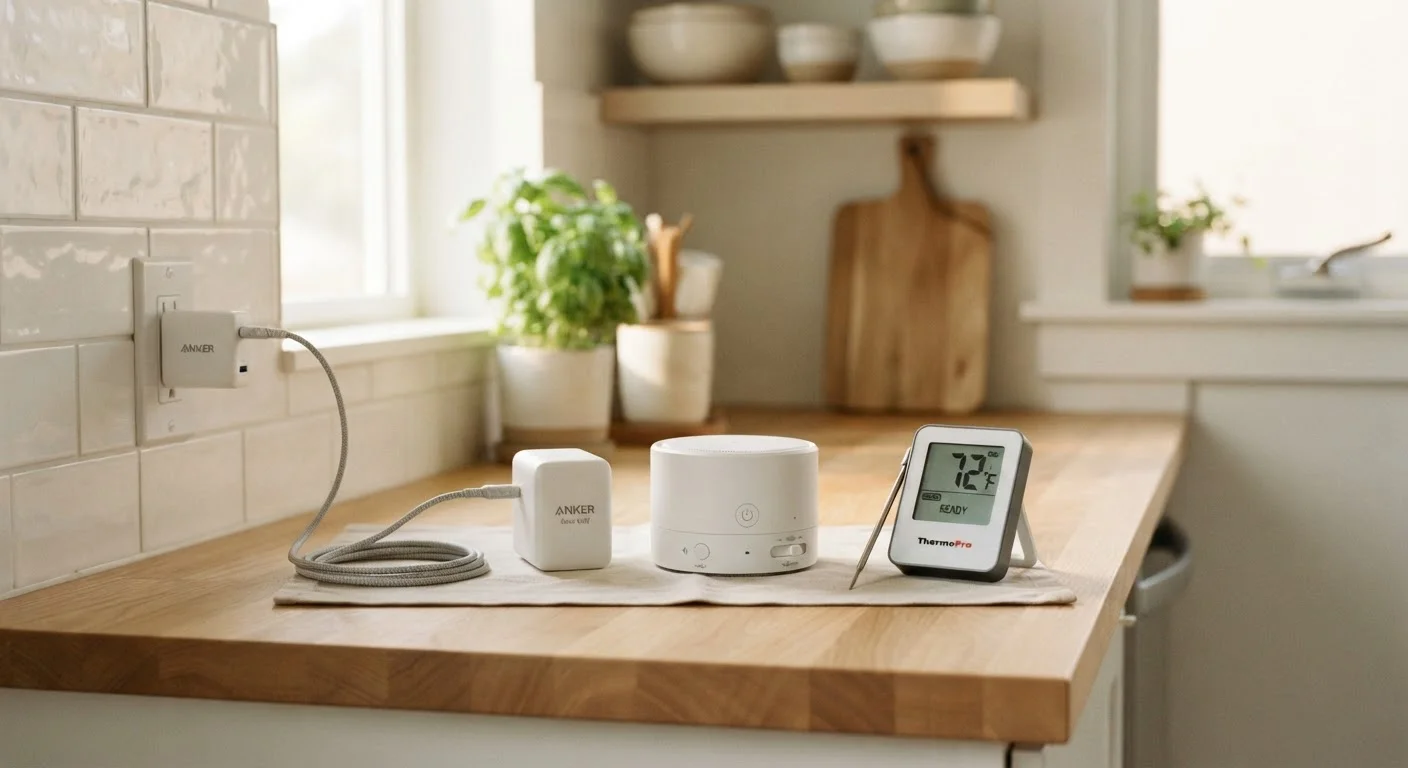
Photo: InfoAlly.net | Finding Info Made Easy editorial
Key Takeaways
- The most useful gadgets solve specific, recurring problems without adding complexity to your day.
- Counter-worthy devices tend to be ones you reach for automatically, not ones you have to remember to use.
- Evaluating a gadget by the problems it eliminates - not its feature count - leads to more satisfying purchases.
- Most genuinely useful devices are low-maintenance and work reliably without constant updates or troubleshooting.
- A gadget earns its place when removing it would noticeably disrupt your normal routine.
Why Some Gadgets Stay and Others Get Buried in a Drawer
Consumer electronics shelves are stacked with devices promising to transform daily life. Most deliver a brief novelty burst, then migrate to a kitchen drawer - or straight to a donation box. The ones that stick share a quiet common trait: they solve a problem you bump into repeatedly, without creating a new one in return.
This list focuses on that second category. These aren't necessarily the most advanced or widely marketed devices. They're the ones that ordinary households tend to reach for without thinking - the gadgets that would genuinely be missed if they disappeared. If you're wondering whether a new purchase will really earn its keep, our pre-purchase checklist is a good place to start.
A dedicated power strip with surge protection
It's easy to overlook a power strip as a gadget, but a surge-protecting model does active work: it absorbs voltage spikes that can occur during thunderstorms or grid fluctuations, acting as a buffer between your electronics and the wall. Standard outlet extenders offer no such protection.
For households with a cluster of devices in one area - a home office desk, an entertainment setup, a bedside charging station - the right power strip quietly reduces risk every single day, without any interaction required from you.
Surge protection works silently every day without any input from the user.
A digital instant-read thermometer
Whether you're checking whether chicken has reached a safe internal temperature, monitoring a child's fever, or troubleshooting a thermostat, a reliable instant-read thermometer eliminates guesswork. Analog dial thermometers drift over time and read slowly; a quality digital model responds in a few seconds and holds calibration well.
This is a device that households often don't own until they clearly need one - at which point they almost always wish they'd had it sooner.
Guesswork is the enemy in both cooking and health - a thermometer removes both.
A white noise machine
White noise machines (sometimes called sound conditioners) produce a consistent, neutral sound that masks irregular background noise - traffic, neighbors, a partner's snoring, early-morning garbage trucks. They don't block sound entirely; they make it predictable enough that the brain stops flagging it as a disturbance.
They're commonly associated with infants, but adults who work from home, live in apartments, or are light sleepers often find them equally valuable. Simple, durable, and requiring no software or updates.
Consistent background sound helps the brain stop treating interruptions as alerts.
A USB-C wall charger with multiple ports
Households typically accumulate a tangle of separate chargers for phones, tablets, earbuds, and small devices. A multi-port USB-C charger consolidates these into a single wall plug, reducing cable clutter and freeing up outlets. Many modern models support faster charging protocols - meaning the same device charges more quickly than with older, single-port bricks.
For situations where wall outlets aren't available at all, a portable power bank covers a different but complementary need.
One multi-port charger replacing four single-port bricks is a small but noticeable daily improvement.
A handheld label maker
Label makers sound mundane until you've used one consistently. Clear labeling on storage bins, freezer containers, cables, kids' belongings, and household supplies eliminates the small but repeated friction of trying to remember what's what. It also reduces the likelihood of throwing away something useful by mistake.
The time investment per label is trivial; the cumulative payoff - in less rummaging and fewer small household disagreements - tends to surprise first-time users.
The friction a label removes is small each time, but it adds up over months and years.
A compact air purifier
Air purifiers with HEPA (High-Efficiency Particulate Air) filtration capture airborne particles - dust, pet dander, pollen, mold spores - that standard HVAC systems leave circulating. For households with allergy sufferers, pets, or anyone sensitive to air quality, a unit sized appropriately for a bedroom or living room runs quietly in the background and requires only periodic filter replacement.
It doesn't claim to cure conditions or guarantee health outcomes, but cleaner indoor air is a measurable and well-documented benefit of effective filtration.
HEPA filtration captures particles your HVAC system routinely misses.
A smart plug (used simply)
A smart plug - an outlet adapter that allows a device to be switched on or off remotely via phone, or on a schedule - earns its keep best when used for exactly one clear purpose rather than as part of a complicated home automation system. Common uses: scheduling a coffee maker to start before you wake up, ensuring a space heater turns off automatically, or confirming remotely that a lamp is off after you've left the house.
Used narrowly, it eliminates a specific recurring worry or habit without requiring any technical knowledge beyond downloading an app. For a contrast on what tech features often overpromise, see our look at smartphone features that rarely change daily life.
A smart plug used for one clear job is far more useful than one wired into a complicated automation scheme.
Getting the Most from the Devices You Already Own
The gadgets listed here can last for years with minimal attention - but some common habits shorten that lifespan unnecessarily. Leaving devices plugged in past full charge, exposing them to excess heat, or using incompatible charging cables are among the most frequent culprits. Our practical guide to extending gadget lifespans covers specific steps that apply to most of the devices above.
Protect devices with simple habits
It's also worth considering how gadgets fit your broader spending habits. A device that solves a real problem is a reasonable investment; one that duplicates something you already own is harder to justify. For a broader look at making purchases that reflect your actual priorities, see our piece on everyday spending habits that align with what you value.
Counter space is finite. The devices that consistently earn it are the ones woven quietly into the texture of your day - not the ones demanding attention, but the ones that simply work.
The content on this site is for informational purposes only and is not a substitute for professional advice. Always consult a qualified professional for guidance specific to your situation.