
A Glossary of Smartphone Specs: What the Numbers on the Box Actually Mean

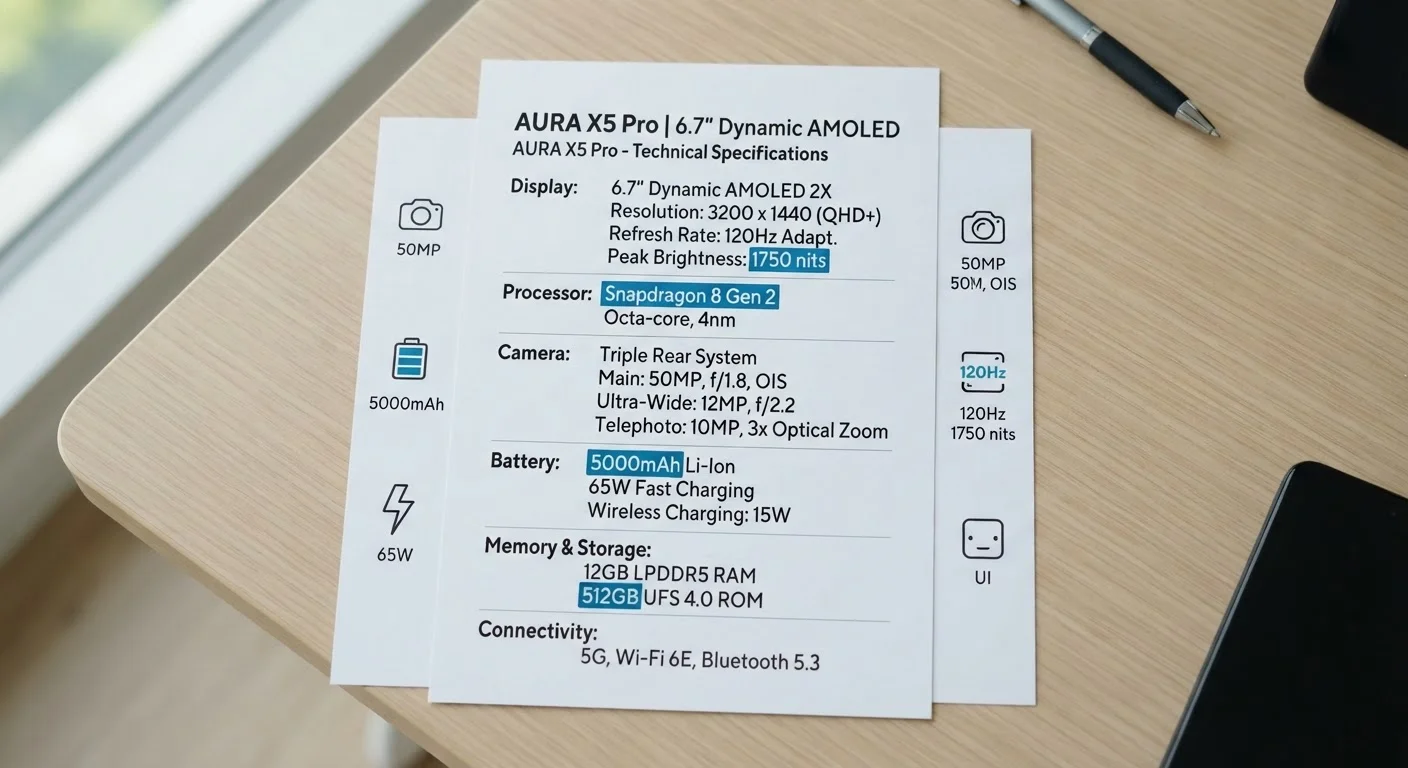
Photo: InfoAlly.net | Finding Info Made Easy editorial
Why Smartphone Specs Can Feel Like a Foreign Language
Smartphone listings are packed with numbers: 12GB RAM, 6.7-inch 120Hz AMOLED, f/1.8 aperture, 5000mAh. These figures are meant to help you compare devices, but without context they're nearly meaningless. This glossary translates the most common terms into plain English so you can make sense of what you're actually looking at.
For a broader look at how to approach spec sheets without getting sidetracked by marketing numbers, see our guide to reading spec sheets. And if you're curious which headline specs rarely affect day-to-day use, this companion piece is worth a read.
RAM
Random Access Memory - the short-term workspace your phone uses to keep apps running. More RAM generally means your phone can handle more apps open at once without slowdowns or reloads, though software optimization also plays a large role.
Refresh Rate (Hz)
How many times per second the screen redraws its image. A 60Hz display refreshes 60 times per second; a 120Hz display refreshes 120 times. Higher refresh rates make scrolling and animations appear smoother, but can consume more battery.
Nits (brightness)
A unit measuring screen brightness. Higher nit counts make a display easier to read in direct sunlight. Displays rated above 1,000 nits are generally considered comfortable for outdoor use in bright conditions.
AMOLED / OLED
Screen technologies where each pixel produces its own light. This allows for true blacks (pixels simply turn off), vibrant contrast, and thinner panels. AMOLED is a Samsung-developed variation; both terms describe the same underlying approach.
LCD
Liquid Crystal Display - a screen technology that uses a backlight shining through a layer of crystals. Generally less vivid than AMOLED but can produce accurate colors and tends to be more affordable to manufacture.
Aperture (f-number)
Describes the size of a camera lens opening, written as f/1.8 or f/2.4. A lower number means a wider opening that captures more light, helping in low-light situations. Most smartphone cameras have a fixed aperture.
Processor (SoC)
System on a Chip - the main processor that handles all computing tasks on a smartphone. It combines the CPU, GPU, and other components into one chip. A newer or higher-tier chip generally means faster performance and better efficiency.
Storage (GB / TB)
The amount of space available for apps, photos, videos, and files. Gigabytes (GB) are the most common unit; 1 terabyte (TB) equals 1,000 GB. Photos and video in high resolution consume storage quickly, so more is usually better for heavy users.
Battery Capacity (mAh)
Milliampere-hours - a measure of how much charge a battery can hold. A higher mAh number generally means longer battery life, though actual endurance depends heavily on the processor, screen size, refresh rate, and software.
5G
The fifth generation of mobile network technology. It offers faster data speeds and lower latency than 4G LTE when connected to a compatible network. Availability depends on your carrier and location.
Megapixels (MP)
One megapixel equals one million individual pixels captured in a photo. More megapixels can allow for larger prints or tighter crops, but image quality also depends heavily on sensor size, lens quality, and software processing.
Optical Image Stabilization (OIS)
A hardware system inside the camera that physically shifts the lens or sensor to compensate for small hand movements while shooting. This reduces blur in photos and helps stabilize video, particularly in low light.
Key Specs Decoded: Display, Performance, and Camera
Once you know what each term measures, patterns become clear. Display specs affect how content looks and feels to use. Performance specs determine how smoothly the phone runs. Camera specs shape photo quality in ways that aren't always obvious from a single number.
| Typical RAM range (modern smartphones) | 6GB-16GB (General industry range; varies by device tier) |
| Common display refresh rates | 60Hz, 90Hz, 120Hz (Standard options across device categories) |
| Outdoor readability threshold (brightness) | ~1,000 nits (General display industry guideline) |
| Average smartphone battery capacity | 4,000-5,000 mAh (General range across mid-to-flagship devices) |
| Minimum storage for most users | 128GB (Common practical recommendation for moderate use) |
| Wide aperture example | f/1.8 (more light) (Standard reference; lower f-number = wider opening) |
One important note on camera aperture: a lower f-number (like f/1.8) means a wider opening, which allows more light in - useful in dim environments. A higher f-number (like f/2.4) means a narrower opening. Most phone cameras have a fixed aperture, so this number is set at manufacture and can't be adjusted the way it can on a standalone camera.
Packaging and connectivity terms like Bluetooth version numbers and IP ratings are covered in our gadget packaging glossary, which pairs well with this reference.
Specs Don't Tell the Whole Story
The content on this site is for informational purposes only and is not a substitute for professional advice. Always consult a qualified professional for guidance specific to your situation.