
A Practical Framework for Comparing Household Cleaning Products

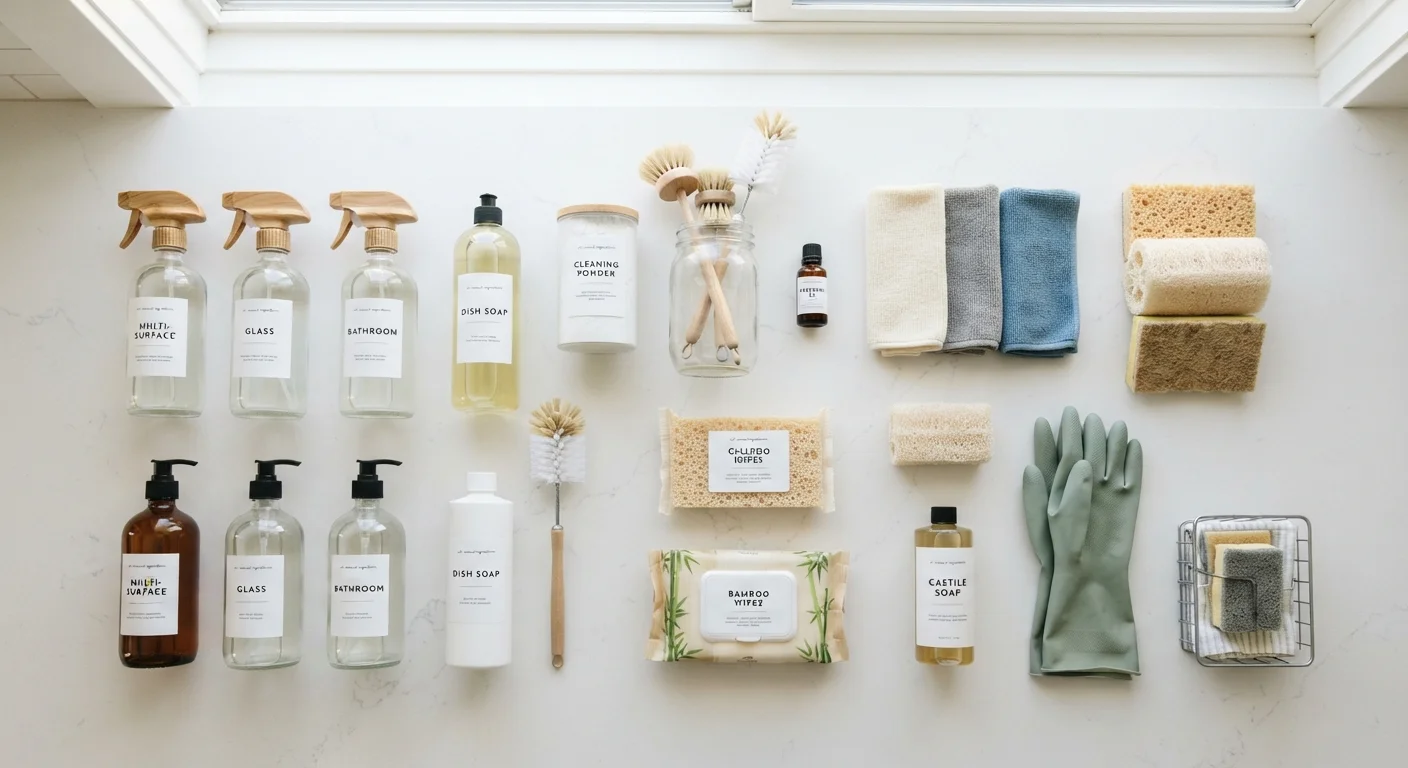
Photo: InfoAlly.net | Finding Info Made Easy editorial
Key Takeaways
- Active ingredients - not brand names - determine how well a cleaner actually works.
- Cost per use is more meaningful than sticker price when comparing cleaning products.
- Surface compatibility and safety considerations should narrow your choices before price does.
- Concentrated formulas and multi-surface products often reduce both spending and storage clutter.
- Third-party certifications offer more reliable safety signals than front-of-bottle marketing claims.
Why Most Product Labels Tell You Very Little
Walk down any cleaning aisle and you'll encounter a parade of promises: "hospital-grade," "plant-powered," "99.9% germ elimination." These phrases are largely marketing shorthand, not regulated performance claims. A product can legally call itself "natural" while still containing synthetic preservatives or undisclosed fragrance compounds.
The more useful habit is to move past the front label entirely. The back panel - specifically the active ingredients list and any signal words like "Caution," "Warning," or "Danger" - tells you far more. Signal words are federally regulated under FIFRA (the Federal Insecticide, Fungicide, and Rodenticide Act) for disinfectants, making them a reliable indicator of relative hazard level. For general cleaners that don't make disinfection claims, ingredient disclosure is less standardized, which is why third-party certifications become a useful shortcut. For a parallel approach to decoding ingredient lists in other product categories, see how ingredient lists reveal what branding obscures.
The Four Criteria That Actually Matter
Comparing cleaning products becomes much simpler when you anchor the evaluation to four criteria - in roughly this order of priority:
- Active ingredient and concentration: Surfactants break down grease; oxidizers like hydrogen peroxide lift stains; acids dissolve mineral deposits; quaternary ammonium compounds disinfect. Knowing which chemistry you need for a task tells you which products are even worth considering.
- Surface compatibility: Abrasive or acidic formulas that work brilliantly on tile can etch natural stone or strip sealants. Always cross-reference the product's listed compatible surfaces before the price tag.
- Cost per use: Divide the price by the number of uses the volume realistically provides. A concentrate that costs more upfront but dilutes 1:32 usually undercuts a ready-to-use spray on a per-use basis by a significant margin.
- Safety and environmental profile: VOC (volatile organic compound) content affects indoor air quality. Aquatic toxicity matters if you're near a septic system. Certifications from programs like EPA Safer Choice or third-party environmental standards offer a meaningful screen here - though they're not the only route to a low-impact product.
| Ready-to-Use Spray | Dilutable Concentrate | Single-Use Wipes | Powder Cleanser | |
|---|---|---|---|---|
| Cost per use | Moderate | Low (high dilution ratio) | High | Low to moderate |
| Convenience | High - no prep needed | Medium - requires diluting | Very high - disposable | Medium - requires water |
| Packaging waste | Moderate | Low | High | Low to moderate |
| Surface versatility | Moderate | High (formula-dependent) | Limited | Low - abrasive |
| Ingredient transparency | Varies by brand | Varies by brand | Often limited | Often clearer |
| Storage footprint | Moderate | Small | Bulky per unit | Small |
Building a purchase decision around these four criteria - rather than packaging aesthetics or scent - tends to produce more consistent satisfaction. For a broader framework you can apply before any significant purchase, structuring your research phase walks through a transferable approach.
Concentrates vs. Ready-to-Use: The Real Cost Calculation
Ready-to-use (RTU) sprays are convenient but typically the most expensive format on a per-use basis. Concentrates require a small upfront behavior change - measuring and diluting - but dramatically reduce packaging waste and cost per application.
Calculate Cost Per Use Before Buying
A simple back-of-envelope check: if a 32 oz RTU spray costs $5 and makes roughly 30 applications, that's about $0.17 per use. A concentrate that costs $12 but makes 64 applications of the same volume comes to $0.19 - but if it makes 128 applications, it's $0.09. The math shifts quickly with dilution ratio. Consumers who apply this kind of unit-cost thinking to everyday shopping - the same logic useful for pantry staples that consistently outperform premium alternatives - often find cleaning products are one of the easiest household categories to optimize.
Multi-surface concentrates also compress the number of products you need to stock, which has its own practical value: fewer SKUs to track, less storage space, and simpler restocking decisions. This aligns with broader intentional-spending principles - separating genuine needs from wants is especially useful when a product lineup has quietly ballooned.
Red Flags and Reliable Signals When Evaluating Any Cleaner
A few patterns reliably indicate a product worth scrutiny:
- Proprietary "blend" language: When a formula is described only as a proprietary blend with no ingredient specifics, there's no way to evaluate chemistry, hazard, or environmental profile.
- Overloaded claims: A product claiming to clean, disinfect, deodorize, and polish a dozen different surfaces simultaneously warrants skepticism. Effective chemistry involves trade-offs.
- No dilution instructions for a concentrate: A product sold as a concentrate that doesn't specify ratios leaves you either over-diluting (reducing effectiveness) or under-diluting (wasting product and money).
Reliable positive signals include: full ingredient disclosure, EPA Safer Choice certification (which screens for human and environmental safety), clear surface compatibility guidance, and consistent independent reviews that focus on functional performance rather than scent preferences. For guidance on reading user reviews critically, making sense of online reviews before a big decision offers a useful filter.
The goal is a short, purposeful cleaning toolkit - products you chose deliberately, not accumulated by default.
The content on this site is for informational purposes only and is not a substitute for professional advice. Always consult a qualified professional for guidance specific to your situation.