
Portable Bluetooth Speakers vs. Smart Speakers: Different Tools for Different Rooms

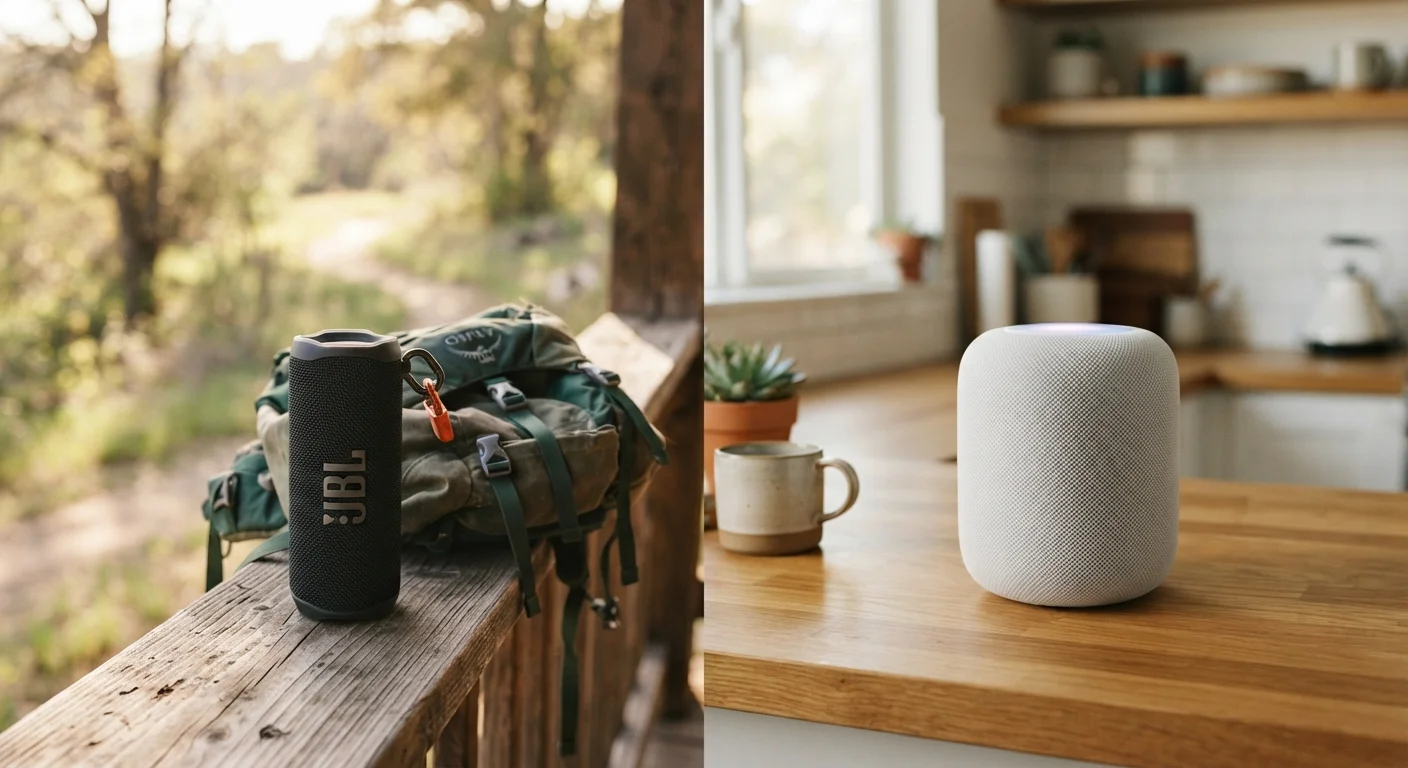
Photo: InfoAlly.net | Finding Info Made Easy editorial
Key Takeaways
- Portable Bluetooth speakers prioritize battery life and durability for use away from home or Wi-Fi.
- Smart speakers stay plugged in and connect via Wi-Fi, enabling voice assistants and smart home control.
- Bluetooth speakers work with any phone or tablet; smart speakers are tied to a specific voice ecosystem.
- Smart speakers generally offer richer home integration but are not designed to leave the room.
- Choosing between them comes down to where you'll use it and what features matter most in that space.
What Each Speaker Actually Does
At first glance, both types play music - so the differences can seem minor. In practice, they're built around completely different assumptions about where and how you'll use them.
A portable Bluetooth speaker is a self-contained audio device. It pairs wirelessly with your phone, tablet, or laptop via Bluetooth - a short-range wireless standard that doesn't require an internet connection. You charge it, pair it, and it works anywhere within roughly 30 feet of your device. Most are compact, and many carry water-resistance ratings suited for outdoor use.
A smart speaker, by contrast, stays plugged into a wall outlet and connects to your home's Wi-Fi network. That persistent internet connection is what makes it "smart": it runs a built-in voice assistant (such as Amazon Alexa or Google Assistant) that can answer questions, set reminders, play streaming music, and communicate with other smart home devices. To understand how these devices fit into a broader connected home, see what smart home tech actually does.
| Criterion | Portable Bluetooth Speaker | Smart Speaker |
|---|---|---|
| Power source | Rechargeable battery | Wall outlet (always plugged in) |
| Connectivity | Bluetooth (short-range, no internet needed) | Wi-Fi (requires home network) |
| Voice assistant | None built in | Built-in (Alexa, Google Assistant, Siri) |
| Smart home control | Not supported | Core feature |
| Portability | Highly portable, travel-ready | Stationary, room-based |
| Setup complexity | Minimal - pair via Bluetooth | Requires app, Wi-Fi, and account |
| Always-on microphone | No | Yes (with physical mute option) |
| Works without internet | Yes | Limited functionality only |
Where Each One Genuinely Shines
The clearest way to choose between them is to think about location first, features second.
Portable Bluetooth Speakers
These speakers thrive anywhere a power outlet isn't guaranteed: a backyard barbecue, a hotel room, a hike, or simply moving from the kitchen to the bathroom during your morning routine. Because they use Bluetooth instead of Wi-Fi, they also work in areas with weak or no internet signal. There's no app to configure and no account required - just hold the pairing button and connect.
Smart Speakers
Smart speakers deliver their greatest value when placed in a fixed, frequently used room - a kitchen counter, a bedside table, or a living-room shelf. Their always-on microphones let you issue hands-free commands without touching your phone. That's genuinely useful when your hands are full of groceries or covered in flour. They also integrate with smart home platforms, meaning you can use one to dim lights, adjust a thermostat, or lock a door by speaking aloud. For guidance on which rooms benefit most from this kind of setup, see our room-by-room automation guide.
~30 ft
Typical Bluetooth speaker range
Standard Bluetooth audio connections generally maintain reliable quality within approximately 30 feet of the paired device, though obstacles can reduce range.
12-24 hrs
Common battery life range for portable speakers
Many mid-range portable Bluetooth speakers advertise battery life in the 12-24 hour range at moderate volume, though real-world results vary by model and usage.
3+
Major smart speaker voice platforms in the US
Amazon Alexa, Google Assistant, and Apple Siri represent the three primary smart speaker ecosystems available to US consumers, each with distinct smart home compatibility.
Practical Trade-Offs Worth Knowing
Neither speaker type is universally superior - each involves real compromises.
Audio quality varies widely within both categories, but smart speakers often have an edge in consistent, tuned sound for a fixed listening position because manufacturers can optimize for a known environment. Portable speakers prioritize compact drivers and battery efficiency, which can limit low-end (bass) performance in smaller units.
Privacy is a consideration unique to smart speakers. Because they use always-on microphones to detect a wake word, some users are uncomfortable with a device that is continuously listening - even passively. Most smart speakers include a physical mute button for the microphone. If this is a concern for you, our beginner's guide to smart speakers covers privacy settings in plain language.
Ecosystem lock-in is another smart-speaker trade-off. Choosing a smart speaker often means committing to a voice platform - Amazon, Google, or Apple - which influences which other smart devices work seamlessly alongside it. Bluetooth speakers carry no such obligation. For more on navigating platform decisions, see how to choose a smart home ecosystem.
Can You Use Both in the Same Home?
The content on this site is for informational purposes only and is not a substitute for professional advice. Always consult a qualified professional for guidance specific to your situation.