
Plug-In Hybrid vs. Full Electric: Which Transition Makes More Sense Right Now

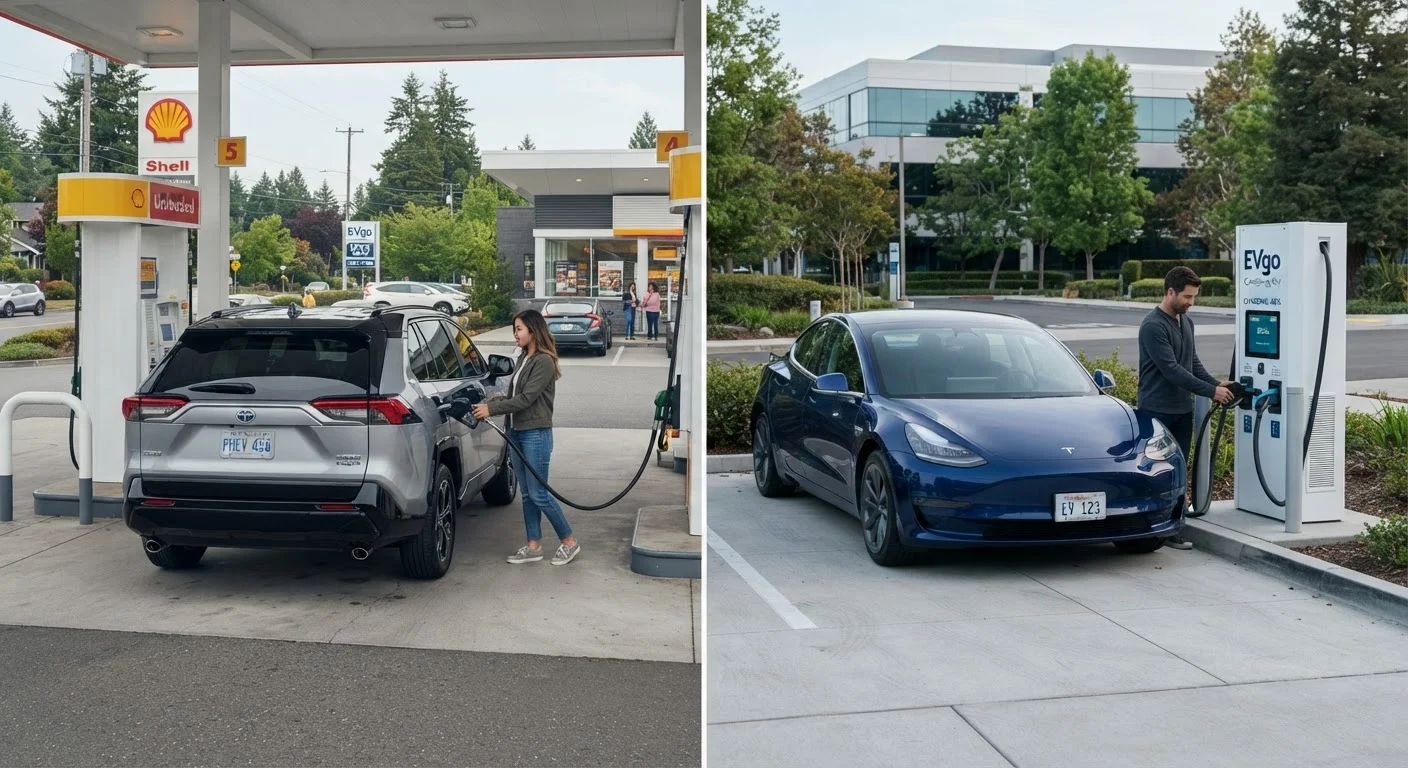
Photo: InfoAlly.net | Finding Info Made Easy editorial
Key Takeaways
- PHEVs reduce range anxiety by pairing a battery with a conventional gas engine, but their electric-only range is typically limited to 20-50 miles.
- BEVs offer zero tailpipe emissions and lower per-mile energy costs, but depend heavily on charging infrastructure access.
- Home charging availability is often the single most decisive factor in whether a BEV works for a given household.
- PHEVs can quietly revert to gas-only operation if the battery isn't regularly charged, negating many of their environmental advantages.
- Neither option is universally superior - the right choice depends on your daily mileage, home setup, and comfort with change.
Understanding What You're Actually Comparing
The terms get used interchangeably in casual conversation, but PHEVs and BEVs work in fundamentally different ways. A plug-in hybrid electric vehicle (PHEV) carries both a battery pack and a traditional internal combustion engine. It can drive on electricity alone for a limited range - typically 20 to 50 miles depending on the model - then seamlessly switches to the gas engine. A battery electric vehicle (BEV) has no combustion engine at all. Its energy comes entirely from the battery, which must be recharged from an external source.
That structural difference shapes nearly every practical trade-off that follows. PHEVs ask less of the infrastructure around you; BEVs demand more commitment but can deliver more consistency once that commitment is met. For a broader look at where EV adoption stands in the US today, see what the shift away from gasoline actually looks like.
| Criterion | PHEV | BEV |
|---|---|---|
| Electric-only range | ~20-50 miles typical | 150-300+ miles typical |
| Fuel flexibility | Gas + electricity | Electricity only |
| Home charging required | Helpful but optional | Strongly recommended |
| Tailpipe emissions | Zero in EV mode; gas otherwise | Zero tailpipe emissions |
| Maintenance complexity | Two drivetrains to maintain | Fewer mechanical components |
| Long-distance travel | No range limitations | Requires charging stop planning |
| Upfront cost (general range) | Mid-range between hybrid and BEV | Generally higher upfront |
| Per-mile energy cost | Lower in EV mode; gas rates otherwise | Typically lower than gas |
The Charging Reality: Where Most Decisions Get Made
For many households, the single most important question isn't range or price - it's charging access. BEV ownership works most smoothly when you can charge overnight at home, waking up each day to a full battery. Without that option, you're dependent on public charging networks that - while growing - still vary widely in availability, speed, and reliability across US regions.
PHEVs sidestep much of this pressure. Even if you never plug one in, it operates as a conventional hybrid. But that convenience has a catch: research from real-world PHEV usage suggests many owners charge inconsistently, which means the vehicle spends significant time running on gas alone - narrowing the environmental and fuel-cost advantage considerably.
~40 miles
Median US daily driving distance
US Department of Transportation data suggests most American drivers travel well under 50 miles on a typical day, placing daily commutes within BEV range.
20-50 miles
Typical PHEV electric-only range
Most current PHEVs offer between 20 and 50 miles of all-electric range before the combustion engine takes over, according to EPA vehicle ratings data.
~80%
EV owners who charge primarily at home
Surveys by the International Council on Clean Transportation have consistently found the large majority of BEV drivers rely on home charging as their primary energy source.
Before committing to a BEV, it's worth reviewing what new owners often discover after purchase. Our guide on EV charging at home covers common surprises around installation, electrical panel capacity, and costs that catch first-timers off guard.
Cost Picture: Beyond the Sticker
Purchase price alone tells an incomplete story for both vehicle types. BEVs generally have higher upfront costs but lower per-mile operating expenses - electricity is typically cheaper than gasoline, and BEVs have fewer moving parts, meaning lower long-term maintenance costs. PHEVs tend to be priced between conventional hybrids and full electrics, but they carry two drivetrains, which can mean more maintenance complexity over time.
Federal tax incentives, where applicable, may affect the out-of-pocket cost of either type - but eligibility rules are specific and subject to change. Consult a tax professional or official government resources for current guidance rather than assuming a credit applies to your situation.
For a detailed look at the full financial picture of EV ownership - including depreciation, insurance, and charging costs - see everything the EV sticker price doesn't tell you.
Range, Anxiety, and Realistic Daily Use
Range anxiety - the fear of running out of charge - is a widely cited barrier to BEV adoption. But the concern is often larger in the abstract than it is in practice for typical drivers. Most US commuters travel fewer than 40 miles per day, well within the range of most modern BEVs. Range anxiety and other EV myths examines where these concerns hold up and where they don't.
PHEVs appeal precisely because they neutralise that anxiety with a fallback. But for drivers whose daily patterns are predictable and whose charging access is reliable, the anxiety may not be justified by actual risk. The honest calculus is personal: assess your own routes, your charging options, and how often you genuinely drive beyond 150 miles in a single day.
If you're still working through the broader readiness question, the pre-purchase EV readiness checklist offers a structured way to evaluate your household's specific situation before making a decision.
This article is for informational and educational purposes only. It does not constitute financial, legal, or purchasing advice. Eligibility for tax incentives and the suitability of any vehicle type depend on individual circumstances - consult qualified professionals before making significant financial decisions.
The content on this site is for informational purposes only and is not a substitute for professional advice. Always consult a qualified professional for guidance specific to your situation.